Ultimate SERMON PREPARATION Guide For Preachers
Foundations and Essentials of Effective Sermon Preparation
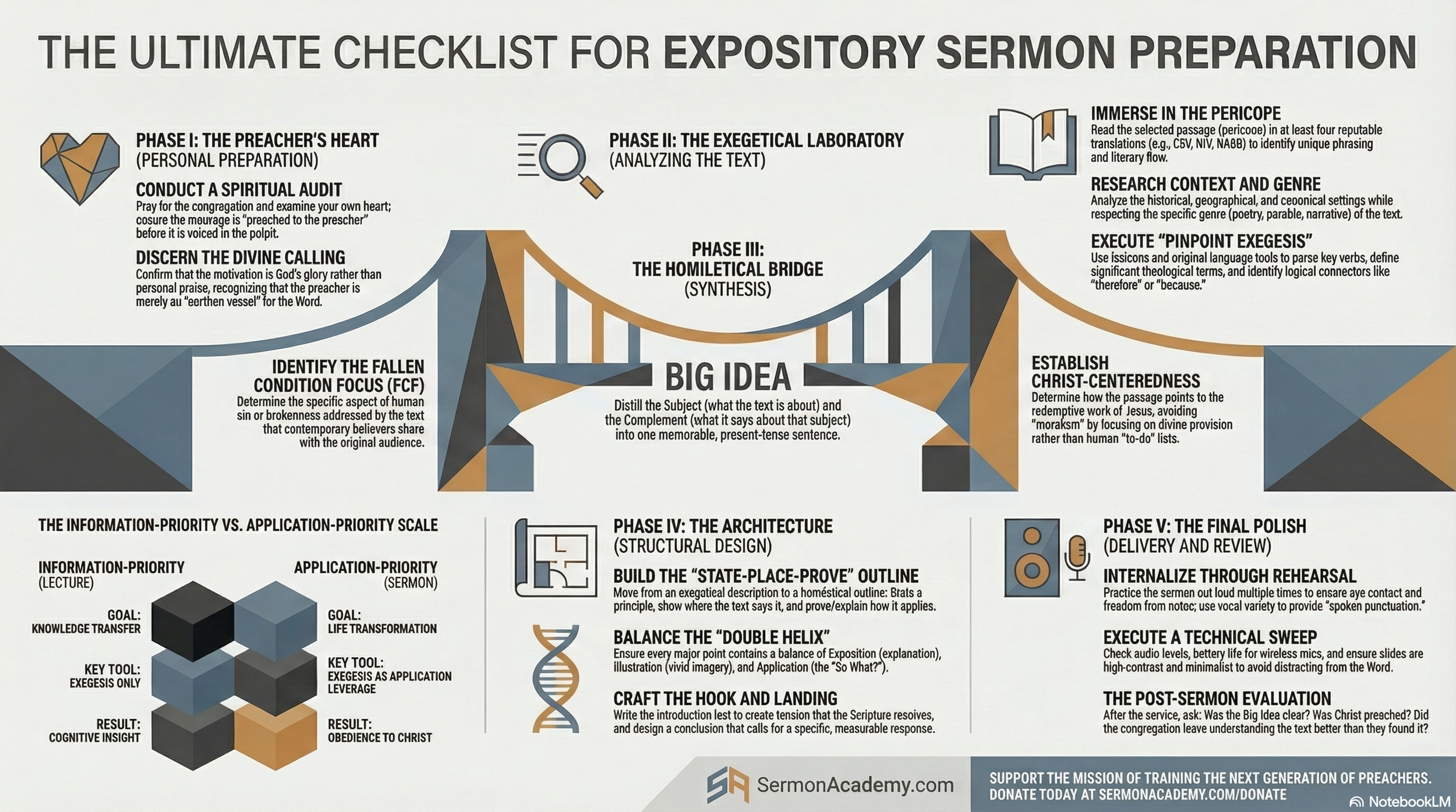
This study guide provides a comprehensive review of the principles and methodologies of sermon preparation, drawing from the insights of leading homileticians including Bryan Chapell, Haddon Robinson, Wayne McDill, and Tim Keller.
Part I: Short-Answer Quiz
Instructions: Answer each of the following questions in two to three sentences based on the provided source materials.
Define expository preaching as described in the source materials.
What are the three classical components of persuasion mentioned by Aristotle and adopted by homileticians, and which one is considered the most powerful?
According to Wayne McDill, why is a "systematic procedure" or preparation system essential for a preacher?
What is the "Fallen Condition Focus" (FCF) and why is it necessary for a sermon?
Explain the difference between an "exegetical idea" and a "homiletical idea."
What are the three main elements of a sermon's "unity" according to Bryan Chapell?
Why is it important for a preacher to study the "redemptive context" of a passage?
How does the "3 A.M. Test" function as a metric for sermon preparation?
According to the provided checklists, what is the specific purpose of an illustration within a sermon?
Why must a preacher prioritize their own "ethos" or character before entering the pulpit?
Part II: Answer Key
Definition of Expository Preaching: Expository preaching is a message where the structure and thought are derived directly from a biblical text, covering its scope and explaining its features and context. Its primary goal is to disclose the enduring principles for faithful living and worship intended by the Holy Spirit.
Classical Components of Persuasion: The three components are logos (verbal content and logic), pathos (emotive features and passion), and ethos (the perceived character and credibility of the speaker). Ethos is considered the most powerful component because listeners evaluate the truth of the message based on the perceived integrity and concern of the preacher.
The Necessity of a Preparation System: A system focuses and enhances the preacher's work, ensuring they make the most effective use of their time while producing better content. It prevents laziness and the tendency to rely on vague "inspiration," instead forcing the preacher into disciplined, careful study and exegesis.
Fallen Condition Focus (FCF): The FCF is the mutual human condition that contemporary believers share with the original biblical audience that requires the grace of the passage. It gives the sermon a purpose by identifying the specific aspect of human brokenness or need that the text addresses, ensuring the message is transformative rather than just informative.
Exegetical vs. Homiletical Ideas: An exegetical idea is a statement of the historical meaning of the text, answering what the author was saying to the original audience. A homiletical idea transforms that exegetical truth into a one-sentence application or "big idea" that is relevant and applicable to the modern listener.
Three Elements of a Sermon: For a sermon to be effective, it must possess unity (one theme), purpose (addressing an FCF), and application (answering the "So what?" question). Without these, a message is merely a series of disparate statements rather than a cohesive tool for transformation.
Redemptive Context: Studying the redemptive context ensures the preacher sees how a specific passage fits into the broader biblical story of God’s grace. It prevents the sermon from becoming a "legalistic" or "man-centered" moral lecture by showing how human predicaments always require a divine solution fulfilled in Christ.
The 3 A.M. Test: This is a test of clarity where a preacher should be able to state the sermon's theme in a single, concise sentence if woken up in the middle of the night. If the theme cannot be stated simply and clearly, it is likely too complex or fragmented for a congregation to grasp on a Sunday morning.
Purpose of Illustration: Illustrations are intended to motivate the audience rather than just explain or inform. They use stories with conflict and resolution to show the results or consequences of applying (or failing to apply) the biblical truth being discussed.
Preacher's Ethos: Pastoral character is the foundation of ministry because a preacher's actions and life testify to the truth of the Word. If a preacher’s life is inconsistent with the message, it creates a "stumbling block" that can discredit the ministry and hinder the listeners' reception of the gospel
Part III: Essay Format Questions
Instructions: Use the provided source materials to develop comprehensive responses to the following prompts.
The Theology of Christ-Centeredness: Compare and contrast a "moralistic" sermon (the "Deadly Be's") with a "redemptive" sermon. Explain why Bryan Chapell argues that even Old Testament texts that do not mention Jesus can be preached as Christ-centered messages.
The Mechanics of Preparation: Analyze the sermon preparation workflows suggested by Haddon Robinson, Tim Keller, and Andy Deane. Identify the common stages shared by all three and discuss the value of utilizing "worksheets" or "checklists" to ensure quality.
The Role of the Listener: Discuss why "Unity" is described as a service to the listener. How do different homiletical structures (deductive, inductive, or narrative) accommodate the way modern audiences process information and stay engaged?
Authority and the Word: Explore the claim that "when the Bible speaks, God speaks." How does this conviction influence an expository preacher's approach to the biblical text compared to a topical approach that might rely more on human reason or social agendas?
Preparation as Spiritual Discipline: Beyond the intellectual work of exegesis, the sources emphasize prayer and personal repentance. Discuss how the preacher’s private devotional life and dependence on the Holy Spirit are considered "essentials" for effective preaching.
Part IV: Glossary of Key Terms
Term
Definition
Big Idea
The single, unifying theme of a passage or sermon that summarizes its core meaning in one sentence.
Block Diagram
A study method of laying out a text to show the relationship between phrases, clauses, and sentences to visualize its logical structure.
Deductive
A sermon structure where the main idea (proposition) is stated at the beginning and then supported by various points throughout the message.
Ethos
The perceived character, integrity, and credibility of the preacher as viewed by the audience.
Exegesis
The process of careful, analytical study of a biblical text to "draw out" the original author's intended meaning.
Expository Sermon
A sermon where the message’s structure and content are derived from and governed by a specific biblical text.
Fallen Condition Focus (FCF)
The specific aspect of the human condition (sin, suffering, or need) addressed by a text that requires divine grace.
Homiletics
The art and science of preparing and delivering sermons.
Inductive
A sermon structure that leads the audience through a series of observations or stories, culminating in the statement of the main idea at the end.
Logos
The verbal content of a message, including its logical arguments, craft, and scriptural accuracy.
Pathos
The emotive features of a sermon, including the speaker’s passion and the emotional experience of the listeners.
Pericope
A specific unit or passage of Scripture (such as a parable or a section of a letter) that forms the basis of a sermon.
Proposition
A concise statement near the beginning of a sermon that presents the main theme or claim that the rest of the message will develop.
Redemptive-Historical
An interpretive lens that views every part of the Bible as a record of God's unfolding plan of redemption for his people.
Synecdoche
A term used to describe "Christ-centered" preaching as representing the entire matrix of God's redemptive work, not just the crucifixion.
The 3 A.M. Test: 5 Surprising Secrets to Preaching Sermons That Actually Stick
1. The 30-Minute Mystery
Decades ago, while clearing out his father’s apartment, a young Haddon Robinson discovered his own childhood diary. In an entry dated from a Thursday evening, he recounted traveling to the First Baptist Church in New York City to hear the legendary Dr. Harry Ironside. The young Robinson recorded an observation that would eventually define a lifetime of scholarship: “Some preachers preach for an hour, and it seems like thirty minutes; others preach for thirty minutes, and it seems like an hour. I wonder what the difference is?”
The modern pulpit often grapples with this same enigma. Many communicators possess impeccable doctrine and a command of the facts, yet their messages fail to move the soul. The issue is rarely a lack of information; it is a lack of what homiletics professor Robert G. Rayburn called "royal structure." Rayburn famously instructed his students that while "Christ is the only King of your studies, homiletics is the queen." Without the "Queen of Studies," preaching descends into a dry recitation of trivia. To move from information transfer to spiritual transformation, we must distill five counter-intuitive takeaways from the masters of expository preaching.
2. Takeaway 1: Pass the "3 A.M. Test" for Radical Unity
The first hallmark of a master communicator is radical unity. This is not merely staying on a single topic, but the relentless pursuit of a "Big Idea"—a single, unifying theme that serves as the sermon's spinal column. Haddon Robinson proposed the "3 A.M. Test" as the gold standard: if your spouse woke you from a deep sleep at 3:00 A.M. and asked what your sermon was about, you should be able to state the theme in one crisp, clear sentence.
If you cannot gather your thoughts in the quiet of the night, your audience will not be able to catch them in the bustle of the morning. Robinson argued that a sermon is fundamentally about one thing. This discipline is vital because it is infinitely easier for a listener to "catch a baseball than a handful of sand." Even if the weight of the ideas is equal, the unified form allows the truth to stick. As Robinson noted:
"A sermon is about one thing... All the features of a well-wrought message reflect, refine, and/or develop one major idea."
3. Takeaway 2: Hunt for the "Fallen Condition Focus" (FCF)
While the Big Idea provides the "what," Bryan Chapell’s concept of the Fallen Condition Focus (FCF) provides the "why." Chapell defines the FCF as the mutual human condition we share with the original biblical audience that requires the divine grace of the text. However, a strategist understands that the FCF is not merely about addressing "felt needs." Rather, its primary purpose is to expose God’s redemptive purposes in order to magnify His glory.
By identifying the specific aspect of human brokenness addressed in a passage, the preacher makes God the "hero" of the text. This shifts the sermon from a mere "grammar lesson" or "history lecture" into a minister of transformation. To synthesize the two: the Big Idea is the baseball you are throwing, while the FCF is the urgent reason the audience must catch it. Without an answer to the "So What?" question, the preacher will inevitably speak to an audience that asks, "Who cares?"
4. Takeaway 3: Beware of the "Deadly Be’s"
A common pitfall in the quest for "practical" preaching is the descent into the "Deadly Be's": Be Like (imitating characters), Be Good (moralistic behavior), and Be Disciplined (human effort). These are not necessarily "evil" in their content; they are deadly because their redemptive context is missing. When we exhort a congregation to "be like David" without anchoring that bravery in God’s prior grace, we promote a Pharisaism that bypasses the saving work of Christ.
True exposition mines for the "gold of grace" in every passage. Whether that grace appears in "Old Testament clothes" or "New Covenant robes," it must be the foundation of every instruction. As the Second Helvetic Confession powerfully asserts: "The preaching of the Word of God is the Word of God." Therefore, we must present holiness not as a product of human striving, but as a joyful response to the divine enablement of the Spirit.
5. Takeaway 4: Ethos Trumps Eloquence
In the classical triad of persuasion, we find Logos (the word), Pathos (the conviction), and Ethos (the character). While many labor over their Logos, Aristotle and modern communication studies agree: Ethos—the perceived character and compassion of the speaker—is the most powerful component of persuasion.
A preacher’s character acts as either a portal or a barrier to the Word. Theologian John Sanderson famously tested a pastoral candidate’s character by playing a softball game with him and calling him "out" on a close play when he was clearly safe. Character "oozes out" of a speaker in inadvertent moments, and listeners are experts at sensing it. As Haddon Robinson warns:
"No place exists where a preacher may hide. Even a large pulpit cannot conceal us from view... The audience does not hear a sermon, they hear a person—they hear you."
6. Takeaway 5: Adopt the "Checklist Manifesto"
Master communicators like Wayne McDill and Kevin Miller reject the notion that "inspiration" justifies a lack of system. In fact, laziness does not help the Holy Spirit; it hinders Him. Strategy-level preparation utilizes a "pre-flight checklist" to ensure the message is balanced and structurally sound before entering the pulpit. This isn't a bureaucratic hurdle; it is a tool for fostering creativity through discipline.
A high-impact workflow utilizes "Rounds of Study" before ever opening a commentary:
Round One: Write your own commentary to note what strikes you.
Round Two: Trace "connector words" (therefore, because) to map the logic.
Round Three: Identify metaphors and key repetitions.
Round Four: Ask the "Christ-context" question—how does this fulfill a theme in the canon?
Essential Checklist Questions:
What is the good news of this text? (Ensure it isn't just a moral harangue).
How can I show God provides more supply than demand? (Miller’s metric for grace).
How will my listener instinctively push back on this truth? (Addressing the skeptical mind).
Do I genuinely love these people? (The ultimate test of Ethos).
Conclusion: Become the Message
The ultimate goal of homiletics is not to expand minds with trivia, but to further the priorities of the gospel. The preacher and the message are inextricably linked; we are "jars of clay" holding a "surpassing power." To preach with authority, one must first submit to the text's own authority.
As Joseph Ruggles Wilson once advised: “Become what you preach and then preach Christ in you.” If your life is the only "living word" your audience encounters this week, the burden of the master communicator is to ensure the message they see is one of grace, not of striving. If we are to solve the "30-minute mystery," we must be people who are as captivated by the glory of God as we want our listeners to be.
Your gift helps us:
Acquire and publish classic Gospel sermons from trusted teachers
Edit, host, and deliver teaching consistently through email and video
Equip people with biblical resources they can share
Expand reach so more people can hear clear, Gospel-centered truth
Choose your impact:
$10/month publish and distribute more sermons consistently
$35/month expand the sermon library (editing, hosting, delivery)
$55/month grow reach through email + video and sustain operations
Best option: Monthly giving (steady support helps us plan, publish, and expand consistently).
Note: Gifts are not tax-deductible because Sermon Academy is a for-profit mission. We use this model to move exponentially faster and reach more people.
Why give to Sermon Academy?
Sound teaching: trusted, Gospel-centered preaching and Bible teaching
Simple access: delivered through email and video so anyone can listen and share
Lasting impact: your support builds a growing library people can return to for years
We’re committed to stewardship and clarity—because this is the Lord’s work, and your generosity matters.
After you give
You’ll receive a confirmation email
You’ll get updates on what we’re publishing and how your support is helping
If you choose monthly giving, you can cancel anytime